
It’s been a while, blog fans. Here’s what’s up with me.
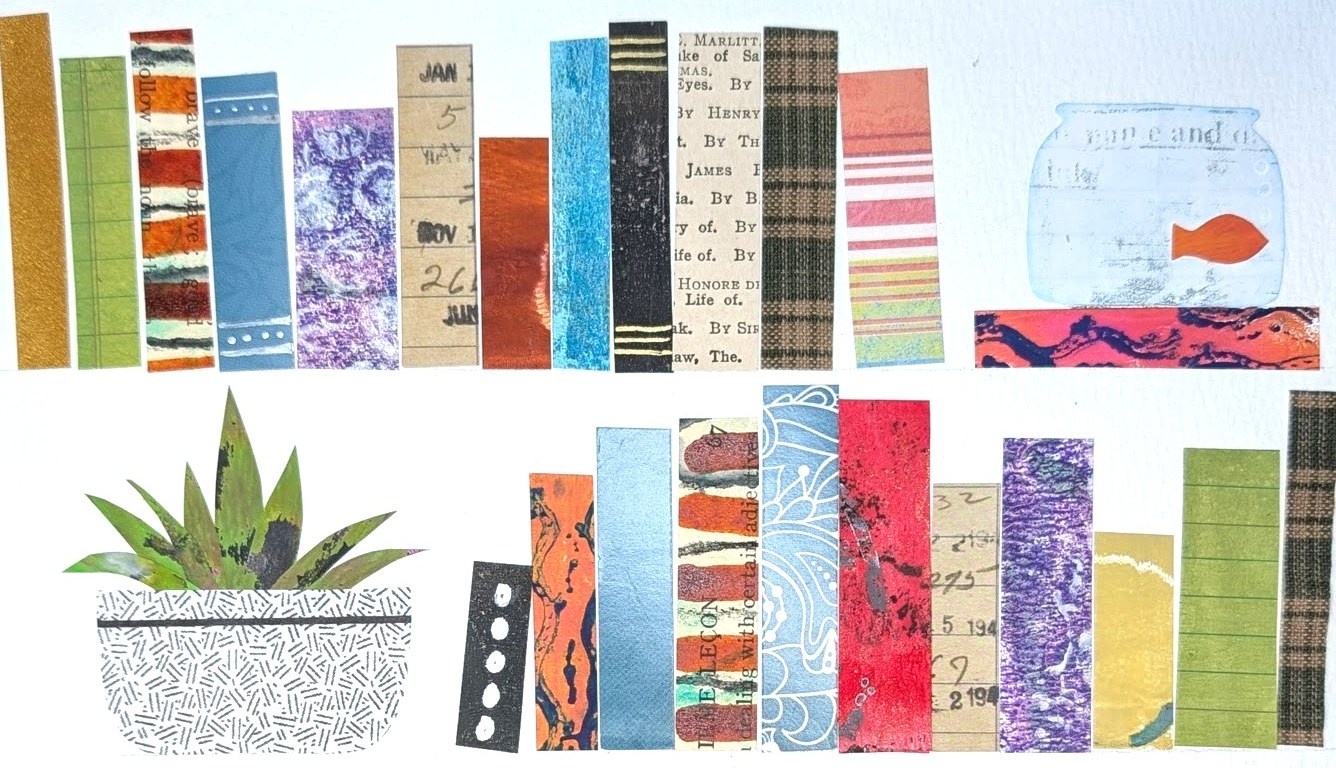
These days I am having a great time making art. Upon retiring over three years ago, I happened to see an ad for a mixed media class that only cost $15. I figured I didn’t have much to lose, and it looked like fun. I clicked on the ad, followed the prompts, and paid my fee. I received a link to the class in my email, and the world of online art classes was revealed to me. I started painting and tearing and gluing, and I haven’t looked back. Now I have an art room filled with supplies, dozens of creations displayed and stacked, and an insatiable curiosity about media and techniques.
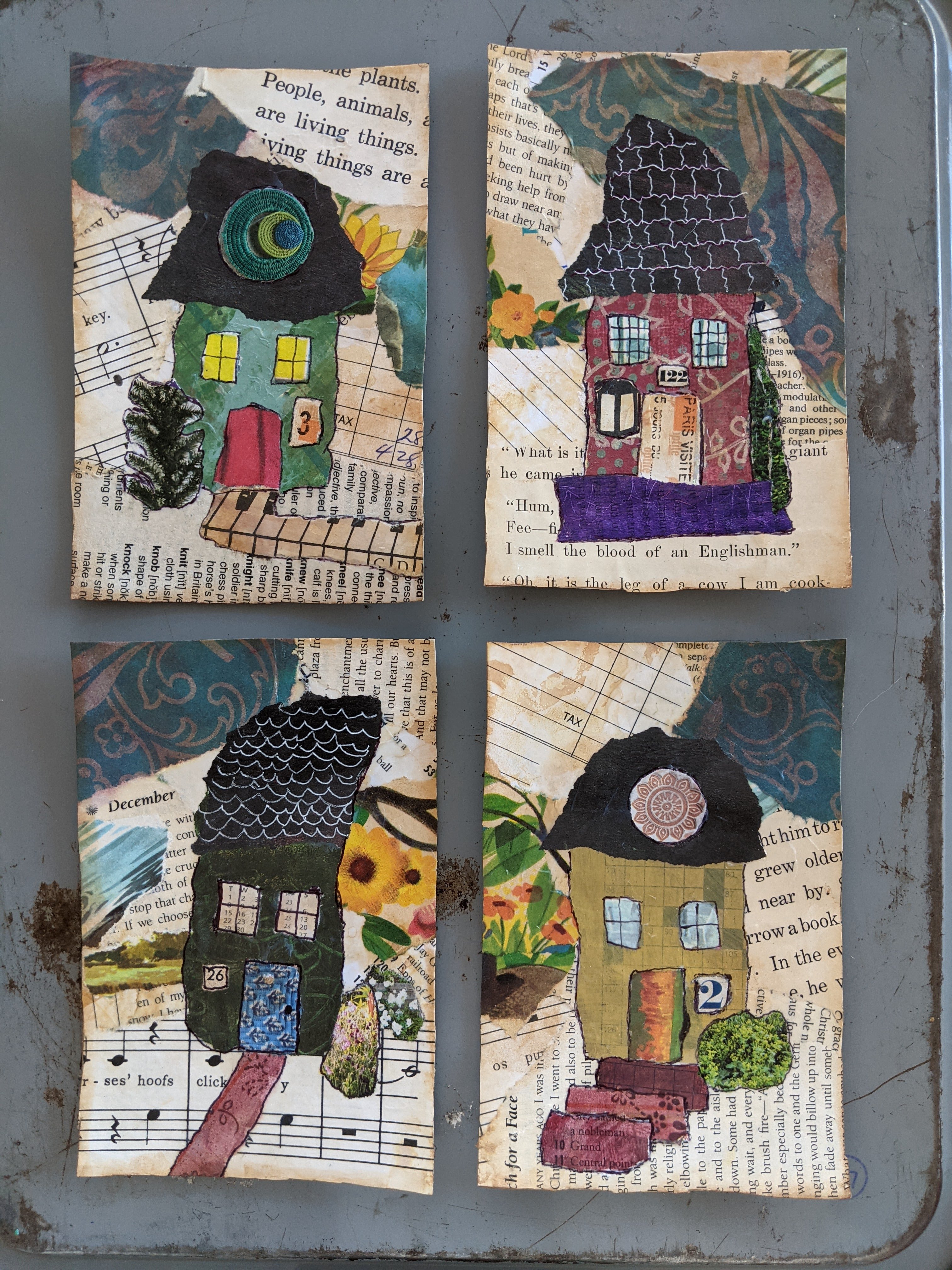
I paid for a yearly subscription to Jennifer Chamberlin’s The Maker Beehive hosted by the first teacher whose “Tiny Tattered Houses” project I relished, renewing the following year. Ready to move beyond folk style collage, I joined Louise Fletcher’s Art Tribe to expand my understanding of different media and styles. Both sources have wonderful Facebook groups whose members encourage exploration and share the joy of making things. It’s been rewarding to post what I make and receive comments. On a given evening you might find me watching one of the many classes about abstract art, drawing faces, etc. provided through the subscription.
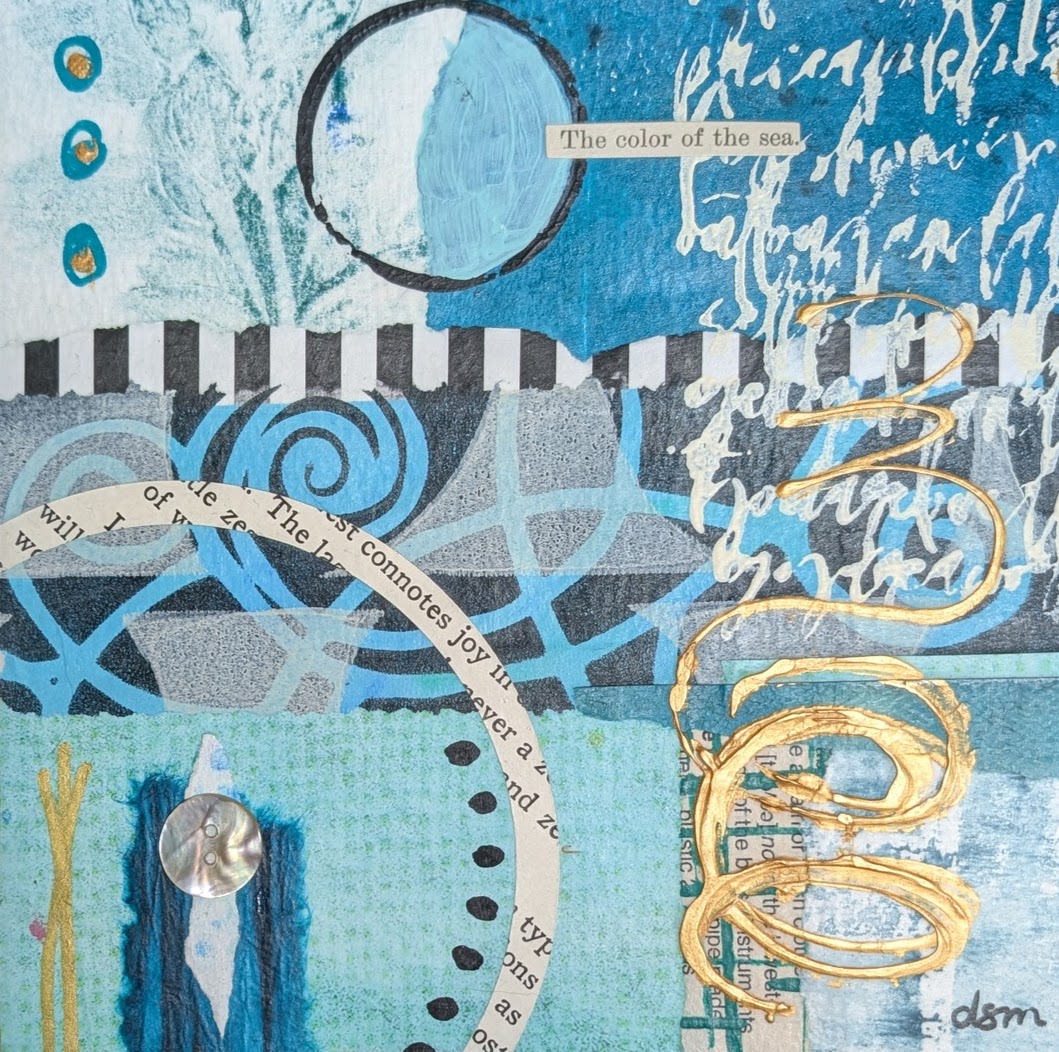
One of the greatest benefits of this artistic chapter is the healing of my lifelong perfectionism. Tearing papers for collage and painting papers with acrylic paints is an inexact exercise. I have to work with what develops. I can paint over things I don’t like. I can tear up a “failure” and use it in a future creation.
I think this has been a liberating experience because visual art is new to me. I don’t have any expectations of doing it well. Nobody else expects me to have the skill of a seasoned artist. I can simply enjoy the process itself and find delight in making even the smallest or simplest creation that pleases me and me only.
In the process, I have found my writing practice drying up. Not at first. In fact I got excited about a writing project that had me working diligently at it for a few weeks. I wanted to write a new kind of Lenten devotional series. I labored over an outline, gathered my previous relevant writings, lined up my sources, and got busy.
I also got bogged down.
About halfway through I submitted it to a couple of trusted readers and took a good look at it myself. It was dry as toast and way too long. (My readers were more kind, but they agreed that it needed a lot of improvement.)
I felt like a failure. I was discouraged, so I put it away for a while to get some perspective. That was two years ago. Consequently I also stopped writing poetry and seldom wrote a blog post.
What I didn’t acknowledge was that it takes a lot of trial and error to be a good writer. Failure is part of the process. It can take years to hone this craft. Why did I expect to write with mastery right out of the gate?
I have long suspected that there is more to this problem than simple discouragement or laziness. I have done a lot of journaling and soul searching to understand my relationship with writing. A huge factor is the culture of my family of origin.
My father was a pastor. My mother came from a family of pastors. A couple were also scholars who wrote and taught seminary courses. So books and good writing were important to my family. We were expected to do well in school, which involves being a good reader and writer. What do we still do for fun? We play Scrabble and do crossword puzzles! Words, words, words.
So the expectations in that department are inherently high for me, in contrast to the expectations about my art practice. The easiest thing would be to give up and concentrate my writing efforts on crafting decent sermons (which I still do regularly whether “decent” or not, given the dearth of pastors and the need for substitutes in local pulpits).
But the desire to write won’t let me go. The trouble is, I have let it fall into the hands of someone who is reluctant to give it back.
Allow me to explain. I am a practitioner of biospiritual focusing[i], a kind of centering and self-examination that involves becoming aware of the sensations/memories/issues that are keeping oneself from feeling all right in the moment. Rather than confronting or dismissing whatever is taking up space inside, one sits with it patiently, with compassion. This is possible to do alone, but it is better with a trained partner.
During a session of focusing with my partner, my writing emerged as an amorphous object. As I sat with it I became aware of something else that was trying to keep it away from me. I realized that it was my shadow self that did not want me to reclaim my writing practice. My shadow self [ii] is the source of my inner critic that accuses me of being a failure, a hack, a snob. She is not attractive.
But I sat with her. I realized that part of her is a natural outgrowth of my expectations about good writing. Nobody intentionally placed these standards on me, but they are active inside me nevertheless. My shadow self is demanding and crafty, but she bears me no ill will. She simply wants me to avoid looking like a fool. She remembers shameful experiences and doesn’t want that to happen again. I can pity her. But I don’t have to let her keep my precious desire to write.[iii]
So I am reclaiming it. I am rediscovering the joy of it, approaching it now with curiosity instead of the pressure to produce something great. Creating art has taught me this. Finding joy in the making is not merely a side benefit; it is the whole point. I can write and not show it to anyone. I can save the one gem in a crappy piece of writing for future work. I can delete it entirely and not regret it, because there is more where that came from. Or I can choose not to do it. Whatever gives me joy is legitimate.
When I make art that I’m not happy with, I don’t feel bad about throwing it away or recycling it for a new project. After all, it’s just paint and paper. At least I learn from every attempt. The same can be true for writing. Every attempt is a learning experience, an expression of myself whether it makes sense or makes an impact. After all, it’s just a little time and some words on a page.
I don’t expect this aspect of my shadow self to recede willingly or permanently. My hangups took time to take shape in the shadows, and I can keep reminding them who is in charge. Gradually the old gal who is so fearful of failure will loosen her grip on my writing self. I’m counting on it.
[i] See Focusing by Eugene T. Gendlin. or Rediscovering the Lost Body-Connection Within Christian Spirituality by Edwin M. McMahon and Peter A. Campbell or check out the BioSpiritual Institute online. I cannot overstate how much this practice has changed my outlook and my relationship with other people. It can be learned fairly easily, but training by experienced teachers has led me to a community of practitioners marked by self-awareness and personal peace that eludes so many in these times.
[ii] Connie Zweig teaches and writes extensively about shadow work.
[iii] I give credit for this insight to Richard C. Schwartz, in his book No Bad Parts.
 saint sinner seeker