       It happened so fast. We had no idea on Saturday morning that the water was blocking off roads. We had a family graveside to go to in Titonka, and we left with the clothes on our backs at 8:00 a.m.
	In Spencer, we get flood watches and warnings every spring, so we don’t pay much attention to them. Unless there is a drought—which we have seen for a few years now—the river routinely overflows its banks around the bridge just south of downtown. The levees that were built after a flood many decades ago always keep the south part of town safe.
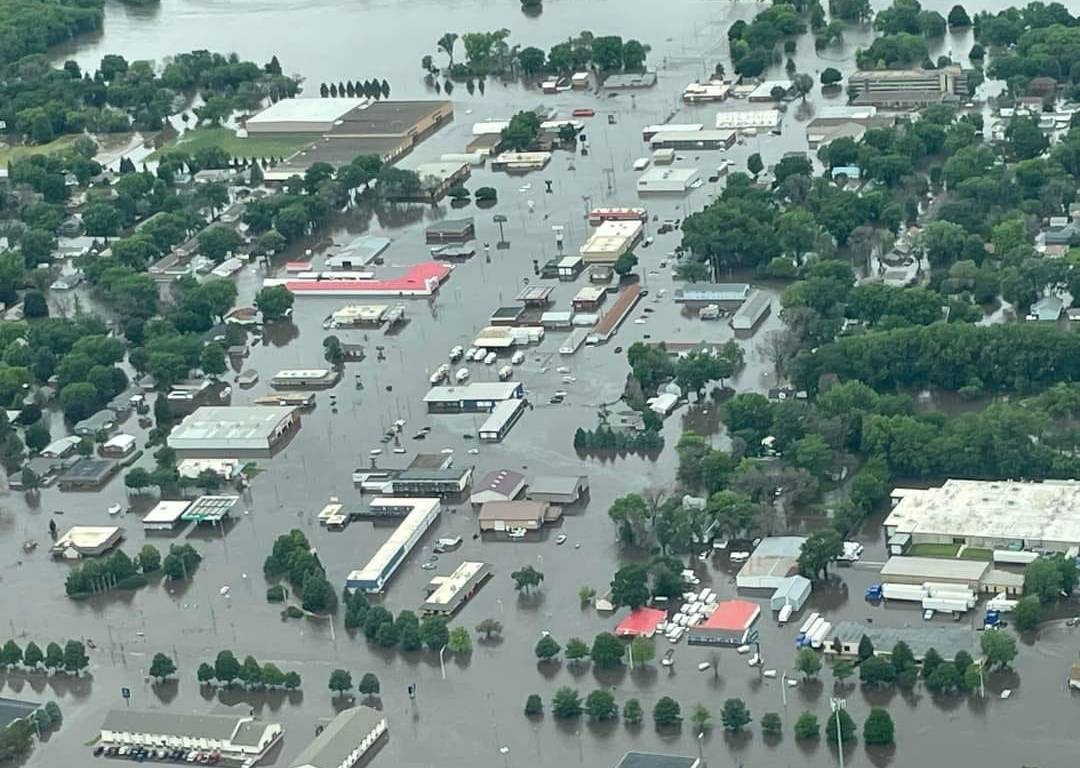
	Nobody could have predicted the volume and speed of the water heading downstream toward us. The town leaders had been warned the night before, but it was far worse than anticipated. They thought the levees with sandbagging would be enough. There was just so much rain northwest of us, and the ground had been saturated in the weeks prior to our disaster. The waters rose to a historic level on June 22 within minutes.
	As we made our way on the east bypass, my husband Dean and I drove the pickup through water that later swept away a man from Illinois. (He drowned in the river, the only fatality.) We realized that we had no route to return home. So, can we get out of town? All of the roads were blocked except the route from Greenville to Gillett Grove, which we determined by trying it ourselves. We took a southern, circuitous route to our destination, since Highway 18 was closed thirty miles to the east.
	We were refugees, unable to return home. Fortunately, we could stay with my husband’s brother in Algona overnight, having bought a change of clothes at the farm store and a few essentials at Hy-Vee. As it happened, I was scheduled to fill the pulpit in two Presbyterian churches there the next day. My nice jumpsuit would have to do; certainly everybody would understand even if I appeared in shorts and a T-shirt.
	My sermon morphed on Saturday evening as I recalled my ideas and jotted notes. I had chosen from the lectionary: “open wide your hearts” from 2 Corinthians 6:13. Fortuitously, it would be useful to my hearers as the waters threatened their community a day or two later. “Open your hearts to each other, to the love of God, to reality,” I told them. I needed those thoughts in the coming days.
	The tiny church in Irvington gave us their new shop vac. The sound engineer in the large church in town gave us a new heavy-duty extension cord he had just purchased. We found an offering envelope with cash and “Spencer flood” scribbled on it, tucked under the wiper of the truck. All were put to good use.
	We bought equipment and groceries, filling the truck before we headed home. I had stayed calm, even peaceful as our situation unfolded. I grew nervous as we approached Spencer, wondering what we would find. We found the northeast route into town. It was strange to drive home on dry streets that were completely normal in that section of town. As we neared our home in the northwest part, we began to see hoses running to the streets, transferring water out of basements.
	At home, we found a house with no power. Our basement was flooded, with totes and our chest freezer floating in 2 ½ feet of water. Soggy cardboard. But it remained about eight inches from the next level where our carpeted family room lies. Our unfinished basement is the bottom of four levels, and we would not have to deal with soggy carpet or drywall. Not bad!
	Despite the “lake” in our backyard, we had escaped mostly unscathed. On the south side of town, there were dozens of people who had thought they had time to gather a few things or make sure their sump pumps were working before evacuating. They had to be rescued in boats, some from the roofs of homes or an elementary school. It is amazing that there was no more loss of life than the gentleman who drowned in his truck.
	 Once we changed our clothes and assessed the situation, my husband spent the rest of the day getting a sump pump to work. His brother’s pump wouldn’t work after fiddling with it for two hours. Friends from Milford brought theirs, but the connection wasn’t right. Third pump was the charm. We removed some water, but the rest had to remain until the water table went down. The pressure from the ground would collapse our basement if we removed all of the water too quickly.
	 Meanwhile I was making use of the coolers and ice our friends brought. Lining toilets with garbage bags and placing kitty litter next to them, since we could not use the sewer system. Throwing out items from the refrigerator. Talking to friends on the phone about their situations,  making sure everybody was all right and had a place to stay.
	 It was eerie to stay in our house without power. I had never realized how dark it is, even during the day. The only light we had at night was from our cell phones. Ours were charged in the truck on the way home. We did not feel isolated because we could use them to communicate.
	 Over the next week the stories of scary experiences reached us. People who got to the hospital in boats. Elderly people found in waist-deep water.

        So much destruction. Our daughter-in-law’s veterinary practice destroyed. A friend’s urgent care clinic that will not reopen. People whose basements did collapse, and they cannot go back in to rescue any of their belongings. Mud and sewage in countless homes on the south side.
       It is a lot to take in.
       It is astonishing to see the volunteer groups that swoop in, from Hy-Vee disaster teams (who knew?) to Samaritan’s Purse that provides extremely skilled leadership complete with trucks and staff, free of charge. Churches leapt into action to be shelters and distribution centers. Neighbors helping neighbors, friends in the countryside offering beds and showers. There is a laundry center set up in the Walmart parking lot by Tide/Proctor and Gamble. I could go on and on.
       Predictably there are those who wanted to blame the authorities for the disaster. Anxious people look for someone to blame. But they were quickly admonished by others. I anticipate that there will be a lot of debate in the coming months when sobering realities hit, but for now the situation is bringing out the best in most people.
       I offered a place to talk and pray at my church, and a few who had enough energy gathered to share stories. We described our mixed emotions of loss, sadness and survivors’ guilt.
In the first few days Dean and I were numb. We did what was urgent, then what made sense. After a few days we assessed what was next and did that. Many times I felt paralyzed and had to let my mind settle into the task at hand. I didn’t cry until I looked at my children’s old mementoes and had to let them go. Tears flowed when learning of friends whose homes are gone. It is all so much.
       When we had no power or sewer I realized how much I distract myself with television or my phone. How much I depend on conveniences like a microwave and restaurants and flush toilets and open streets. How privileged I am to make healthy food and use curated ingredients when so many people have to buy what the Dollar Store offers, if that is even available to them. I am not a saver, but I still have too much stuff.
       A good friend called me in tears six days after the flood, needing to talk. She had been helping at the shelters. At my kitchen table she crumpled in tears at the enormity of the sadness and the need she saw. Cried over her guilt at having a home untouched while others are suffering. I get it.
Like her, I can help other people haul sewage and mud drenched items out of their basements, make sandwiches for workers, offer our concrobium foggers to neighbors to kill and prevent mold. But I am visiting the need, like going on a mission trip and coming home to my comfortable life. I am not in solidarity with the people who are suffering, not really.
       I am grateful for having training in spiritual direction and bio spiritual focusing, equipped with the skills of listening to others and to my own body as I go through this. Contemplative practices are serving me well. Still, waves of sadness overwhelm at times.
       I am realizing that transformation is taking place within me. Richard Rohr’s “order-disorder-reorder” pattern has me right in the middle of disorder. So I must open my heart and be patient, be gentle with my feelings of confusion and sadness. Let the change come and let go of past assumptions. Let the peace of Christ flow within as I sit in the unknowing.
	I am grateful for the chance to see so many people rising to the occasion. They remind me to offer compassion and understanding to others and to give generously. In a time of great political turmoil, I am seeing so much good all around, and that will be true six months from now.
	This has been an experience of good teamwork with my husband. He is a fixer at heart, so he is in his element. Every day we talk about what is next, who needs our help, what needs cleaning and replacing. It has drawn us even closer together.
       As our son said a few days after the flood, if this has to happen to us, it is good to have our faith in humanity restored. I see that as God here, all around. We are not alone.

Note: This account is from only one of several small towns in northwest Iowa that were flooded.


 saint sinner seeker
Thank you, Deb. Well written.
B
Barbara E Ambrosius
2001 W 10TH ST
Spencer, IA 51301
712-262-4421 (H)
712-260-0958 (C)
LikeLike
You’re welcome.
LikeLike